In more than thirty years of caring for eyes across Monterey County, some of the most rewarding moments in my practice come from patients who arrived convinced that nothing more could be done. They have keratoconus, an irregular cornea, a corneal transplant in their history, or dry eye so severe that regular contacts are unbearable, and somewhere along the way they were told their options had run out. Often, they have not. A specialty lens called a scleral lens has changed what is possible for hard-to-fit eyes, and it is one of the specialty options I offer as part of our contact lens services. If clear, comfortable vision has felt out of reach for you, here is what I want you to understand.
A Different Kind of Lens
A standard contact lens sits directly on the cornea, the clear dome at the front of your eye. That works well when the cornea is smooth and regularly shaped. But when the cornea is warped, scarred, or unusually sensitive, a lens resting on it can be blurry, unstable, and genuinely uncomfortable. A scleral lens solves the problem by never touching the cornea at all.
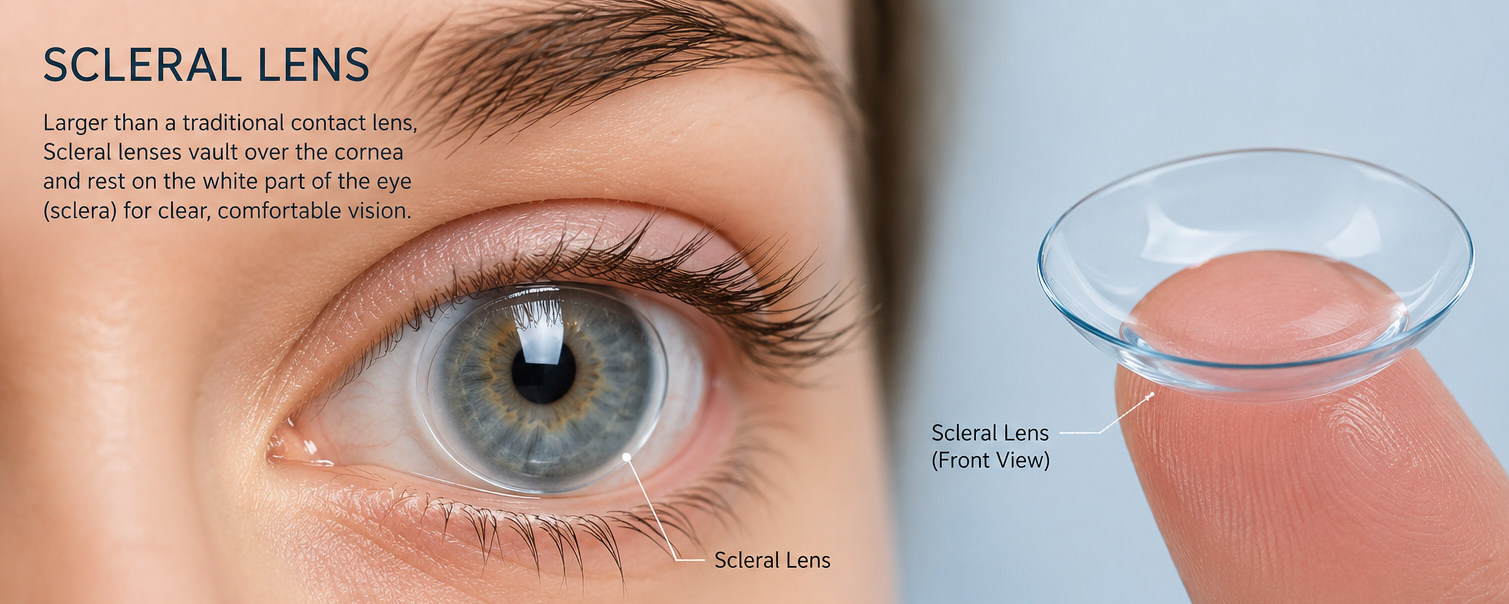
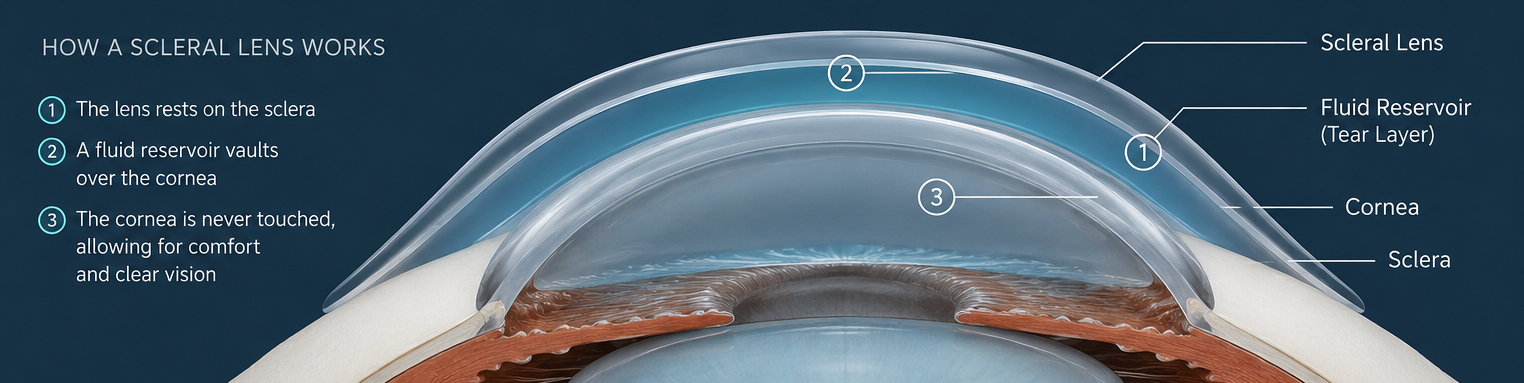
A large, highly breathable gas-permeable lens that arches completely over the cornea and rests gently on the sclera, the white of the eye, which is far less sensitive. The dome it creates is filled with sterile fluid, so the eye is cushioned and bathed all day rather than pressed upon.
Because a scleral lens is wider than a regular contact and lands on the white of the eye instead of the delicate cornea, it stays remarkably stable. It does not shift with every blink, rotate out of position, or pop out during activity. And the space between the lens and your cornea is filled with preservative-free saline before you put it in, creating a smooth reservoir of fluid that does two things at once: it acts like a liquid bandage that continuously hydrates a sensitive eye, and it optically cancels out an irregular corneal surface so light can focus cleanly. In effect, the fluid replaces your bumpy cornea with a perfectly smooth optical surface.
Who They Help
Scleral lenses are not for everyone, and I would never suggest they replace the everyday soft lenses that work beautifully for most of my patients. They exist for the harder cases, the eyes that regular lenses and glasses leave behind.
The only way to know which group you fall into is a proper evaluation. Corneas that look similar on the surface can behave very differently once I map them, which is why I never assume. I measure. That attention to detail is exactly where a hard-to-fit eye is either helped or overlooked.
Comfort & Clarity
Two things tend to astonish my first-time scleral wearers. The first is comfort. Because the lens vaults over the cornea and rests on the less-sensitive white of the eye, many people find this type of lens comfortable from the very first day, even eyes that could never tolerate a regular contact. Most of my patients wear them comfortably for twelve to sixteen hours at a stretch. The second is clarity. By replacing an irregular cornea with a smooth layer of fluid, scleral lenses routinely restore vision that glasses and standard contacts simply could not deliver.
There is a bigger picture here, too. For some patients with advanced keratoconus, a scleral lens is not just about better vision. It can help postpone or even avoid the need for a corneal transplant. In one published study of severe keratoconus, long-term scleral lens wear successfully managed the majority of eyes and cut the need for corneal transplant surgery by more than half.
A well-fit scleral lens can turn a cornea that surgery might otherwise have to repair into one that simply needs a lens each morning. For the eyes it fits, that is a genuinely meaningful difference.
The Fitting Process
A scleral lens is custom-made for the individual eye, so fitting one is more involved than pulling a box of contacts off a shelf, and that extra care is exactly why the results are so good. Here is how the process usually unfolds in my office.
Mapping your eye
I image the surface of your cornea and sclera in detail, so I understand the exact shape I am designing around.
Trying diagnostic lenses
You try on trial lenses in the office so I can watch how each one vaults the cornea and check your vision through it.
Customizing your lens
I fine-tune the measurements (curvature, size, and optics) and order a lens made specifically for your eye.
Learning to wear them
I teach you how to fill, insert, and remove your lenses with confidence. It takes a little practice, and it quickly becomes routine.
Following up
I check the fit and your eye health over time and adjust as needed, so your lenses keep performing as your eyes change.
It is a thoughtful process rather than a quick one, and for the eyes that need it, the payoff of stable, comfortable, clear vision that nothing else could provide is well worth the care that goes into it.
I believe everyone deserves a real shot at clear, comfortable vision, and hard-to-fit eyes are not out of options. Keratoconus, corneal scarring, post-surgical distortion, and severe dry eye were once the end of the road for good vision in contacts. Today, they are often the very reason a scleral lens works so well. If you have been told nothing more can be done for your eyes, I would welcome the chance to take a closer look. It may simply be time for a different kind of lens.
If glasses and regular contacts have never quite worked for your eyes, sit down with me for a specialty lens evaluation and let us find out whether scleral lenses are the answer.
Locations
We have 4 locations the greater Monterey area
“Welcoming space, friendly staff. Doctors are very knowledgeable. I went in to update my prescription and they recommended other things to help with my near sightedness. They also promote eye care.”
–Michael, 5-Star Review