Most people spend months deciding to have cataract surgery, and barely a minute deciding which lens goes in their eye for good. I understand why. In most minds, the procedure is a relatively simple fix. The cloudy vision goes away and life returns to normal. That is true, but it undersells what is really happening on the day of your procedure.
I have been performing cataract surgery on the Monterey Peninsula for more than thirty years, and I tell my patients the same thing I want to tell you here: The lens I place during surgery is designed to stay in your eye for the rest of your life, and while exchanging it later is technically possible, that is a second operation almost nobody plans for. In every practical sense, you get one chance to make this choice well. That makes it a rare and genuine opportunity, not just to remove a cataract, but to correct a lifetime of nearsightedness, farsightedness, and astigmatism at the same moment. If you are considering cataract surgery in Monterey, CA, it is worth understanding why this decision deserves more thought than most people give it.
A Decision Built to Last
A cataract is simply the clouding of your eye’s natural lens, the clear structure that sits behind your pupil and focuses light onto your retina. During surgery, I gently remove that clouded lens and replace it with a permanent artificial one called an intraocular lens, or IOL.
A clear, artificial lens that permanently takes the place of your eye’s clouded natural lens. A cataract cannot form on an artificial lens, and your IOL is designed to stay in place for life, so the lens you choose sets your day-to-day vision for decades to come.
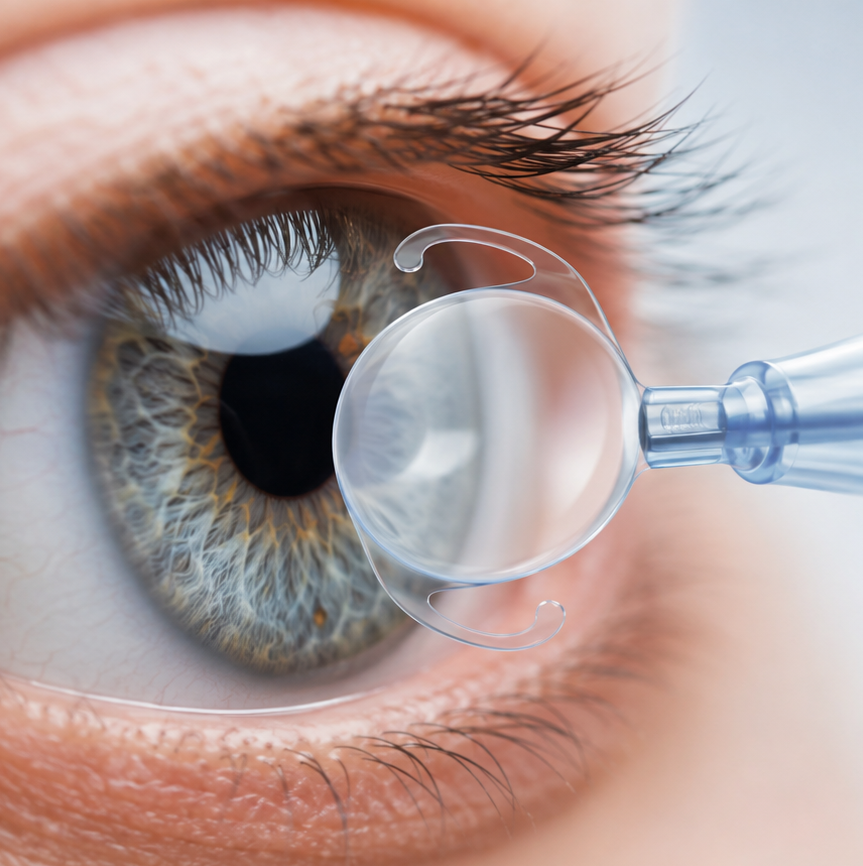
Here is the part that surprises people. That new lens is built to stay with you for good. Your eye does not grow another one, and although an IOL can be exchanged in uncommon situations, doing so means returning to the operating room for a more delicate procedure than the original surgery. No one should count on a do-over. That is why I never treat the choice of lens as an afterthought.
For decades you may have depended on glasses or contacts to bring the world into focus, and cataract surgery is the single moment when we can build that correction directly into your eye. Choose well, and many patients find themselves reaching for glasses far less often, sometimes not at all. Treat it as a routine swap, and you may clear the cloudiness only to leave your nearsightedness or astigmatism exactly where it was.
“I remind every patient that we are not just removing a cataract, we are choosing a lens they should never have to think about again. That is a decision worth getting right the first time.”
Choosing Your Lens
Not long ago, cataract surgery offered essentially one option: a standard monofocal lens focused at a single distance. It is still an excellent, dependable choice. But today’s advanced-technology lenses can do far more, and the right one depends entirely on how you live. Here is how the main options compare.

| What matters to you | Monofocal Standard |
Extended Depth Vivity, Symfony |
Trifocal PanOptix |
|---|---|---|---|
| Distance (driving, TV) | Sharp | Sharp | Sharp |
| Intermediate (computer, dashboard) | Limited | Strong | Strong |
| Near (reading, phone) | Readers needed | Some | Strong |
| Corrects astigmatism | Toric option | Toric option | Toric option |
| Glasses use afterward | Most tasks | Occasional | Rarely |
There is no single “best” lens on this chart, only the best lens for your eyes, your habits, and your priorities. That is exactly the conversation I want to have with you, and the reason I offer the full menu rather than a single default.
Choosing Your Surgeon
A lens is only as good as the surgeon placing it and the plan behind it. Choosing the right IOL means measuring your eye precisely, understanding your daily life, and implanting the lens with the accuracy a result meant to last a lifetime deserves. That judgment is earned over years, not weekends.
A Distinction That Matters
I was the first surgeon in Monterey County to implant the ReSTOR®, PanOptix®, Symfony™, and Vivity™ lenses, the very technologies that make a vision upgrade possible.
I share this not to recite a résumé, but because when a decision is permanent, experience is not a luxury. Being early to each new generation of premium lenses has given me something you cannot rush, a real feel for which technologies suit which patients, and the honesty to tell you when a lens is not right for you. When you sit down with me, you are drawing on all of that judgment, applied to your one procedure.
The Procedure
For all the weight of the decision, the surgery itself is remarkably gentle. It is an outpatient procedure, usually finished in well under half an hour per eye, and you are awake but comfortable throughout. Here is how it unfolds.
A tiny opening
I make a precise incision only about two millimeters wide, small enough that it seals itself without stitches.
Removing the cataract
Gentle ultrasound energy softens and removes the clouded lens. Laser-assisted technology is available to add precision to key steps.
Placing your new lens
Your chosen IOL is folded through that tiny opening and settles gently into place, where it is designed to stay for good.
Home the same day
You head home within the hour, notice your vision clearing over the next few days, and return to your routine quickly.
The takeaway is that the experience is straightforward and well-established, which frees you to focus your energy on the part that truly shapes your future, choosing the lens and the surgeon.
Quick Answers
Sit down with me to explore which lens fits your eyes and your life, before a procedure you should only ever need once.
Locations
We have 4 locations the greater Monterey area
“Welcoming space, friendly staff. Doctors are very knowledgeable. I went in to update my prescription and they recommended other things to help with my near sightedness. They also promote eye care.”
–Michael, 5-Star Review